
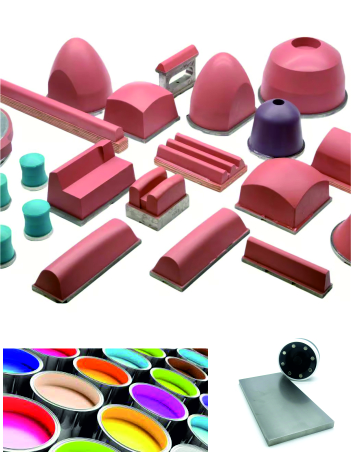
Pad printing is a precision printing process used to transfer images, text, and graphics on surfaces that are flat, curved, or irregular. This versatile technique is widely used in industries such as automotive, electronics, promotional products, medical devices, toys, and consumer goods.
At the heart of this process are three critical consumables: pad printing pads, printing plates (clichés), and pad printing inks. Understanding these components is key to consistent print quality, durability, and production efficiency.
1. Pad Printing Pads
What Are They?
Pad printing pads are made of silicone rubber and serve as the intermediary between the etched plate and the product surface. They pick up ink from the plate and transfer it accurately to the part to be printed.
Key Features
-
Material: High-quality silicone rubber
-
Durometer (Hardness): Soft, medium, and hard grades
-
Shape Options: Round, oval, square, and custom contours
How They Work
The silicone pad presses onto the inked plate, picks up the inked design, and then compresses against the component surface to transfer the image.
Selection Guidelines
-
Soft pads: Ideal for deeply curved, irregular, or textured surfaces
-
Medium pads: Best for general use
-
Hard pads: Provide high detail definition on flat surfaces
Performance Benefits
-
Excellent ink transfer accuracy
-
Wide substrate compatibility
-
Long working life with proper care
2. Printing Plates (Clichés)
Definition
Printing plates — commonly known as clichés — are etched metal or polymer plates that carry the graphic image to be printed. The etched areas hold the ink until it is picked up by the pad.
Types of Plates
-
Photopolymer Plates
-
Cost-effective
-
Best for short to medium print runs
-
-
Steel Plates
-
Highly durable
-
Ideal for long runs and fine details
-
Manufacturing Considerations
-
Etch depth: Determines ink volume and print density
-
Plate thickness: Influences durability and compatibility with machines
-
Quality of artwork: Directly affects print clarity
Plate Selection Tips
-
Use steel plates for high production volumes
-
Choose photopolymer plates for prototyping and short run jobs
3. Pad Printing Inks
What Are Pad Printing Inks?
Pad printing inks are specially formulated to adhere to the target surface and resist abrasion, chemicals, and environmental exposure.
Ink Categories
-
Solvent-based inks: Most commonly used in industrial applications
-
2-Component (2K) inks: Offer superior adhesion and durability
-
UV-curable inks: Fast curing for specialized applications
Ink Properties to Consider
-
Adhesion: Must bond to the specific substrate material
-
Chemical resistance: Essential for automotive and industrial parts
-
Heat resistance: Critical for components exposed to high temperatures
-
Curing method: Heat cure, air dry, or UV cure depending on production needs
Reviews
There are no reviews yet.